products
‹
›
‹
›
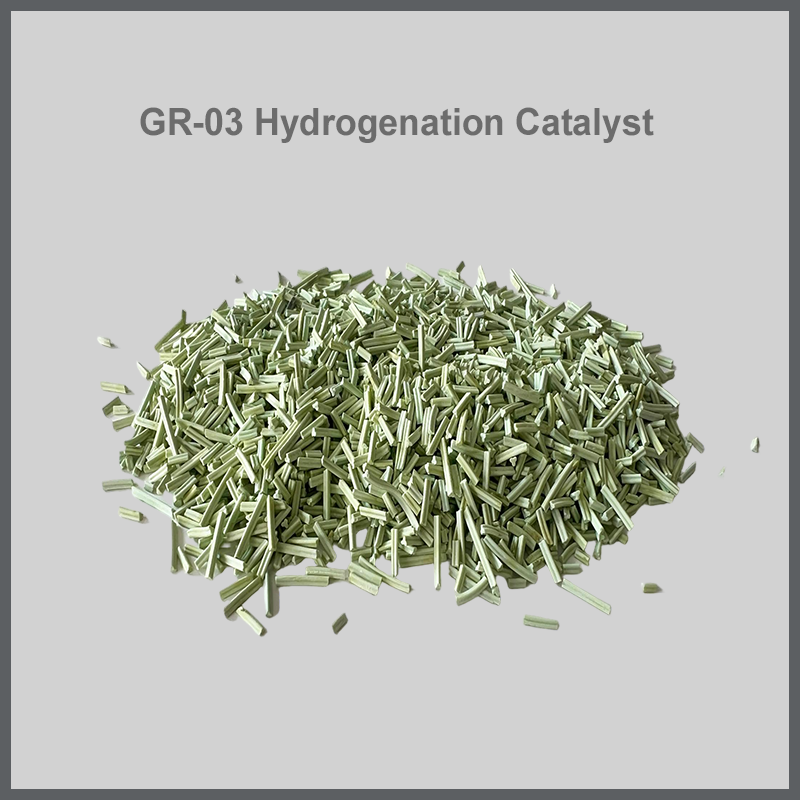
GR-03 Hydrogenation Catalyst
It is primarily used in the pretreatment of feedstocks such as natural gas, coking dry gas, catalytic dry gas, liquefied petroleum gas, and naphtha, effectively removing olefins and organic sulfur compounds. Through hydrogenation, it converts unstable olefins into stable alkanes while simultaneously converting difficult-to-remove organic sulfur into easily removable hydrogen sulfide, significantly reducing the processing burden in subsequent stages and protecting valuable downstream catalysts.
Product Description
GR-03catalyst is an olefin saturation and organic sulfur hydrogenation catalyst with modified y-Al203as carrier and nickel, cobalt, and molybdenum as active metal components. It is suitable for the refining treatment of natural gas, coking dry gas, catalytic dry gas, and other refinery gas, LPG, naphtha, and other hydrocarbon conversion hydrogen production raw materials. This group of catalysts has the characteristics of low activation temperature, low bulk ratio, large pore volume and specific surface area, uniform distribution of active components, high hydrogenation activity and organic sulfur hydrogenolysis activity, and good activity stability. Its comprehensive performance and technical indicators have reached an international advanced level, and it is in a leading position in technology in China.

Product Parameters
FAQ
1.What types of organic sulfur compounds can the GR-03 catalyst process?
The catalyst effectively processes simple organic sulfur compounds such as mercaptans, sulfides, and disulfides. It also has a certain conversion capacity for some complex organic sulfur compounds, converting them to H₂S through hydrogenation and hydrogenolysis.
2.What are the practical benefits of the catalyst's low-temperature activation?
Low-temperature activation means a shorter temperature ramp-up time during unit startup, lowering energy consumption. It also reduces the adverse effects of high temperatures on the catalyst structure and equipment, thereby lowering startup costs.
3.How do the catalyst's large pore volume and specific surface area contribute to performance?
Large pore volume and specific surface area provide more active sites and better reactant mass transfer channels, facilitating the processing of large hydrocarbons and sulfides, improving reaction efficiency and the catalyst's fouling tolerance.
4.What processes are this catalyst primarily used for?
It is primarily used in the pretreatment of hydrocarbon feedstocks prior to hydrogen production, such as the refining of coking dry gas and catalytic dry gas, and the hydrotreating of liquid hydrocarbons such as naphtha, to ensure that downstream conversion catalysts are not poisoned.
5.What is the mechanical strength of the catalyst?
Using a modified alumina carrier, the catalyst has excellent mechanical strength and anti-abrasion properties, adapting to the loading requirements of industrial reactors and long-term operation conditions while reducing dust generation.
Request a Quote
Related Recommendations